Showing posts with label history. Show all posts

Saturday, April 5, 2014

Historical photos of Cleveland streetcars

Cleveland's regional transit authority maintains only rail-based public transportation in Ohio. The 37-mile system comprises a mixture of traditional light rail and a unique heavy rail transit system which uses an overhead catenary instead of a third rail.

The system, while fairly robust for a city of its size, is merely a shadow of what it used to be nearly 100 years ago. Below thick layers of asphalt, lying dormant, are the bricks and rails that stitched together this incredibly efficient people-moving system. In several parts of the city, a streetcar stop was never more than a quarter-mile away (today, in Shaker Heights, it's still a half mile). Single-track interurban lines would run as far as Chagrin Falls, Chardon, and beyond. The map on the upper left encompasses seven miles centering on University Circle around 1925, just as Cleveland Heights, on the eastern half of the map, was under construction. 

Recently some of the history of the local streetcar system has popped up in my news feed.

Cleveland Scene posted some historic photos of the streetcar system today. Check them out by following the link here. 

Cleveland Public Library has posted an avant-garde film, filmed in the summer of 1953, of the last runs of the streetcar system. Watch as the delicatessens roll by, ticket-takers exchange niceties with the passengers, and as an added bonus, the streetcar arrives at the underground Detroit-West 25th station. Link here for first part, link here for second part.


Tuesday, April 30, 2013

Cleveland's "Big Italy" neighborhood

It's hard to visit Cleveland without becoming aware of its Little Italy neighborhood, and the celebrated nature of its Italian population. If you find a few old-timers around there willing to reminisce, you might find out about a second Italian neighborhood called Big Italy, settled around the turn of the century, and at one time containing a 93% Sicilian population. This was one of the more densely populated neighborhoods of the city, located near just southwest of the city center off Woodland Avenue:


The reason most of us have never heard of this once bustling neighborhood was because of urban renewal during the 1950s. The neighborhood's population had fallen from a high of over 4,000 in 1910 to a mere 1,300 by 1940, prompting city developers to solve this urban blight issue using then state-of-the-art urban planning: building a freeway.


Thankfully, this kind of questionable urban planning has largely fallen out of favor due to the way it disrupts the organic growth and evolution of a city. Downtown population growth today is largely constrained by a lack of vacant residential units. This freeway project overlaid and eliminated downtown's only adjoining residential district. Had this project not occurred, how much different would the city center look today?

Sunday, April 28, 2013

Intermodal transit - 1934 to today

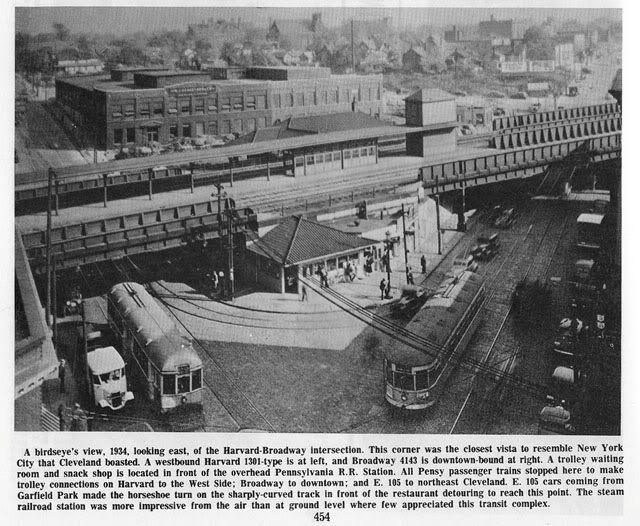
The intersection of Harvard and Broadway Avenues once hosted a busy intermodal transit hub, where commuters made their connections between the Pennsylvania Railroad passenger trains and local streetcars running to all points in the city.

(Source: http://www.urbanohio.com/forum2/index.php/topic,25500.105.html)


By contrast, here's a Street View of the intersection as it looks today:


View Larger Map

One can make out the streetcar tracks still coming through the asphalt. Here was a place where commuters by the thousands per day would make their train changes to get home or get to another city. Did our culture change, or was it forced to change by that layer of asphalt poured over those streetcar tracks?

One such person responsible for the change in transportation habits in Cleveland was Albert S. Porter, the long-serving Cuyahoga County Engineer who was best known for progressive acts like bulldozing entire ethnic neighborhoods in favor of freeway interchanges, stopping downtown subway plans even after voter approval, and ultimately shutting down the streetcar system in 1954. For some hilarious further reading, check out this vitriolic, yet amusing essay about Porter, courtesy the KSU's Collective Urban Design Collective (appearing in the book "Cleveland Stories: True Until Proven Otherwise," pub. 2011).